
Overview
(Click on an item to expand its details)
LocationDhahan Kaleran, Shaheed Bhagat Singh Nagar district, Punjab
4 years (8 semesters)
Scheduling is set by Inder Kumar (IK) Gujral Punjab Technical University. Please refer to https://ptu.ac.in/ for more information.
Semesters begin in July and January. Programs begin in July.
Fees are set by Inder Kumar (IK) Gujral Punjab Technical University. Please refer to https://ptu.ac.in/fees-structure/ for more information.
Students should have an additional budget to pay for uniforms, hostel stays, meals, transportation, etc. These fees are not included in tuition.
For example:
Hostel fee: ₹30,000/- per semester (for the 2025 – 2026 year)
Uniform fee: ₹3,500
Radiology technician (i.e. radiographer), radiology assistant, MRI technician, ultrasound technician (i.e. diagnostic medical sonographer), CT/CAT scan technologist (i.e. computerized tomography technologist), mammography technologist, bone densitometry technologist, radiation therapist (i.e. radiology nurse), nuclear medicine technologist, angiography technologist, interventional radiologist assistant, radiation safety officer, radiation protection specialist, radiology manager.
Students may undergo further education to become a professor.
₹20,000 to ₹40,000 monthly
10+2 with at least 50% aggregate marks on a matriculation examination (medical stream), with 55% marks in Physics & Chemistry and Biology. SC/ST/OBC candidates must achieve 50% and 45% marks of the same.
Important: please see full admission and application requirements here.
Varies from year to year, based on schedules released by Inder Kumar (IK) Gujral Punjab Technical University.
Please refer to https://ptu.ac.in/ for full application details relevant to the year in which you are applying.
Varies from year to year, based on schedules released by Inder Kumar (IK) Gujral Punjab Technical University. See note above.
Optional, on-campus housing
Inder Kumar (IK) Gujral Punjab Technical University in Kapurthala, Punjab.
30
Note: no seats are reserved for specific candidates (such as those from special castes or tribes).
Minimum 75% attendance (irrespective of the kind of absence) in theory, for both core and electives.
100% attendance in practical segments for each course or subject.
Minimum 45% marks to pass each subject.
Maximum 6 years to complete all courses and exams.
Between 17 & 35 years old
None
Medically fit, Hepatitis-B vaccination, COVID-19 vaccination. Tetanus and other communicable disease vaccinations are also recommended.
Program description


The Bachelor of Science in Radiology & Imaging Technology (BSc RIT) program prepares students to work in radio imaging diagnostic centres, namely in hospitals and clinics.
Both theoretical and practical learning modalities are used to teach human physiology, as well as the technical aspects of equipment functionality. Students acquire knowledge in classrooms, laboratories, clinical settings and field trips. Assignments, examinations and practicals are used for evaluation.
The program offers foundational courses on the human body and the physics that take place in diagnostic imaging.
Students are trained to use diagnostic imaging equipment such as X-rays, mammography & ultrasound sonography (USG), magnetic resonance imaging (MRI) and computed tomography (CT). Training utilizes modern standards, with computed radiology (CR) and digital radiology.
Specialized techniques, such as using contrast media (i.e. cholangiography), angiography, image post-processing and imaging on various parts of the body are taught. Basic instruction on nuclear medicine and interventional radiology is given.
Job preparation includes an understanding of radiation safety standards, infection control, emergency care, patient care, computer programs and hardware and other essential skills for working in a medical setting.
English language writing, reading and conversational ability are taught to increase employability.
Human capacity subjects are also covered, highlighting the importance of environmental protection, traffic safety, de-addiction and holistic health in communities.
Program syllabus
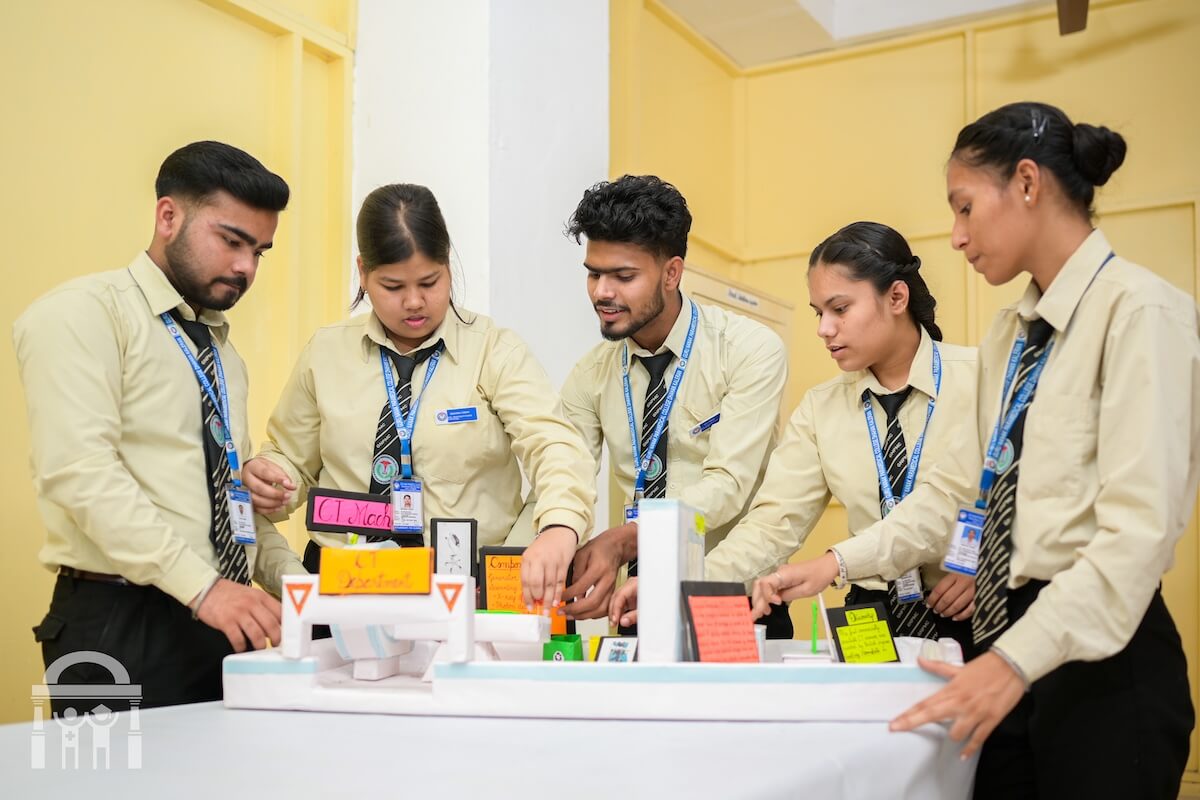
Note: the syllabus below is set to be updated in the near future. Please take this only as a guide.
Semester I
- BRIT 101-21 – Human Anatomy & Physiology-I
- BRIT 102-21 – Basic physics including Radiological Physics
- BRIT 103-21 – Conventional Radiography and Equipment
- BRIT 104-21 – Human Anatomy & Physiology-I Practical
- BRIT 105-21 – Basic physics including Radiological Physics Practical
- BRIT 106-21 – Conventional Radiography and Equipments Practical
- BTHU 103-18 – English
- BTHU 104-18 – English Practical/Laboratory
- HVPE 101-18 – Human Values, De-addiction & Traffic Rules
- HVPE 102-18 – Human Values, De-addiction & Traffic Rules (Lab/Seminar)
Semester II
- BRIT 201-21 – Human Anatomy & Physiology-II
- BRIT 202-21 – Fundamentals of Medical Imaging Modalities
- BRIT 203-21 – Radiation Safety & Protection AERB Guidelines
- BRIT 204-21 – Human Anatomy & Physiology-II Practical
- BRIT 205-21 – Fundamentals of Medical Imaging Modalities Practical
- BRIT 206-21 – Radiation Safety & Protection AERB Guidelines Practical
- EVS 102-18 – Environmental Studies
- BMPD 202-18 – Mentoring & Professional Development
Semester III
- BRIT 301-21 – Equipments of Modern Imaging Technology
- BRIT 302-21 – Contrast and Special Radiographic Procedures
- BRIT 303-21 – Clinical Radiography Positioning
- BRIT 304-21 – Equipments of Modern Imaging Technology Practical
- BRIT 305-21 – Contrast and Special Radiographic Procedures Practical
- BRIT 306-21 – Clinical Radiography Positioning Practical
- BRIT 307-21 – Introduction to Quality & Patient Safety
Semester IV
- BRIT 401-21 – Physics of Newer Imaging Modalities
- BRIT 402-21 – Interventional Radiological Techniques
- BRIT 403-21 – Advance Techniques and Instrumentation of MRI
- BRIT 404-21 – Physics of Newer Imaging Modalities Practical
- BRIT 405-21 – Interventional Radiological Techniques Practical
- BRIT 406-21 – Advance Techniques and Instrumentation of MRI Practical
- BRIT 407-21 – Basic in Computers and Information Science
- BRIT 408-21 – Basic in Computers and Information Science (Practical)
Semester V
- BRIT 501-21 – Magnetic Resonance Imaging
- BRIT 502-21 – Nuclear Medicine Technology
- BRIT 503-21 – Patient Care and Management
- BRIT 504-21 – Interventional Procedure and Technique
- BRIT 551-21 – Practical Magnetic Resonance Imaging
- BRIT 552-21 – Practical Nuclear Medicine
- BRIT 553-21 – Clinical Posting
Semester VI
- BRIT 601-21 – Research Methodology and Biostatistics
- BRIT 602-21 – Orientation in Clinical Sciences
- BRIT 603-21 – Advanced Radiological Modalities
- BRIT 604-21 – Hospital Management
- BRIT 651-21 – Advanced Radiological Modalities
- BRIT 652-21 – Practical Clinical Posting
- BRIT 653-21 – Practical – Seminars, Journal Clubs and Procedures
Semester VII and VIII
Internship