
Overview
(Click on an item to expand its details)
LocationDhahan Kaleran, Shaheed Bhagat Singh Nagar district, Punjab
2 years (4 semesters)
Scheduling is set by Inder Kumar (IK) Gujral Punjab Technical University. Please refer to https://ptu.ac.in/ for more information.
Semesters begin in July and January. Programs begin in July.
Fees are set by Inder Kumar (IK) Gujral Punjab Technical University. Please refer to https://ptu.ac.in/fees-structure/ for more information.
Students should have an additional budget to pay for uniforms, hostel stays, meals, transportation, etc. These fees are not included in tuition.
For example:
Hostel fee: ₹30,000/- per semester (for the 2025 – 2026 year)
Uniform fee: ₹3,500
Assistant professor, academic researcher, medical laboratory manager, medical laboratory technologist or technician, pathologist’s assistant, phlebotomist, infection control analyst, quality control technician, forensic lab technician, public health inspector, laboratory manager, healthcare administrator, hospital outreach coordinator, medical officer, research associate.
Students may undergo further education to become a professor.
₹30,000 to ₹50,000 monthly
Bachelor of Science in Medical Laboratory Sciences (BSc MLS), Bachelor of Science with Honours in Microbiology or Bachelor of Science in any medical stream, with at least 50% marks (or 45% in the case of reserved categories).
Important: please see full admission requirements on the Inder Kumar (IK) Gujral Punjab Technical University website: https://ptu.ac.in/admission-2023-24/eligibility-criteria/#1649240290952-ff2a1720-016a
Varies from year to year, based on schedules released by Inder Kumar (IK) Gujral Punjab Technical University.
Please refer to https://ptu.ac.in/ for full application details relevant to the year in which you are applying.
Varies from year to year, based on schedules released by Inder Kumar (IK) Gujral Punjab Technical University. See note above.
Optional, on-campus housing
Inder Kumar (IK) Gujral Punjab Technical University in Kapurthala, Punjab.
30
Note: no seats are reserved for specific candidates (such as those from special castes or tribes).
Minimum 75% attendance (irrespective of the kind of absence) in theory, for both core and electives.
100% attendance in practical segments for each course or subject.
Minimum 45% marks to pass each subject.
Maximum 4 years to complete all courses and exams.
None
None
Medically fit, Hepatitis-B vaccination, COVID-19 vaccination. Tetanus and other communicable disease vaccinations are also recommended.
Program description

The Master of Science (MSc) in Medical Microbiology is an advancement of the Bachelor of Science in Medical Laboratory Sciences (BSc MLS), or other bachelor’s degrees within the medical field. Upon completion, Master’s holders can apply for management, academic and research positions in colleges, universities, hospitals and laboratories.
In this allied health training program, studies focus more deeply on human biology and the diseases and disorders that affect it. This provides a stronger understanding of specific diagnostic techniques that can be performed in a lab.
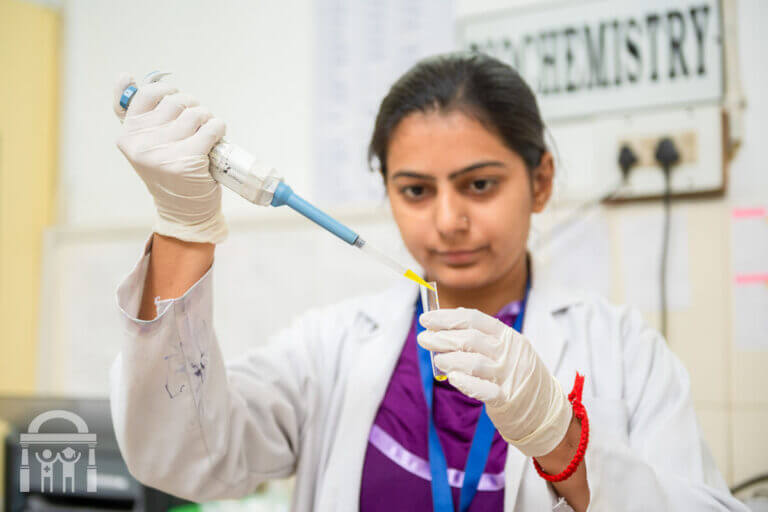
Students learn to classify several viruses, bacteria, fungi, pathogens and other microscopic cells. Various testing methods are taught and practiced; students are taught to cut and stain tissues, analyze clones, count cells, introduce hosts, synthesize chemicals and more.
Academic research is stressed through course subjects on scientific theorization, hypothesis formulation and other research methods. Students learn to prepare reports with proper citations and medical writing styles.
On the practical side, students learn standardized workplace practices such as agent clearing, specimen preparation, quality control, automation, sterilization and biosafety procedures, plus other laboratory techniques.
Successful completion is based on the passing of theory-based examinations, completing assignments and participating in practical lab work.
The last semester provides an opportunity to learn through an internship while simultaneously preparing a dissertation on a research topic.
Program syllabus
Semester I
- MMB-101-21 – Human Anatomy and Core theory Physiology
- MMB-102-21 – Clinical Microbiology
- MMB-103-21 – Clinical Biochemistry
- MMB-104-21 – Immunology
- MMB-105-21 – Human Anatomy and Physiology Lab (Practical)
- MMB-106-21 – Clinical Microbiology Lab
- MMB-107-21 – Clinical Biochemistry Lab
- MMB-108-21 – Seminar/Presentations (Elective Practical)
Semester II
- MMB-201-21- Systemic Bacteriology
- MMB-202-21 – Hematology
- MMB-203-21 – Medical Biotechniques
- MMB-204-21 – Elements of Molecular Biology
- MMB-205-21 – Parasitology
- MMB-206-21 – Systemic Bacteriology Laboratory (Practical)
- MMB-207-21 – Medical Biotechniques Laboratory (Practical)
- MMB-208-21 – Hematology Laboratory (Practical)
- MMB-209-21 – Seminar/Workshops (Elective Practical)
Semester III
- MMB-301-21 – Virology and Mycology
- MMB-302-21 – Biostatistics
- MMB-303-21 – Histopathology and Cytology
- MMB-304-21 – Fundamentals of Scientific Writing
- MMB-305-21 – Microbial Biotechnology and Quality Assurance (Elective)
- MMB-306-21 – Virology and Mycology Laboratory (Practical)
- MMB-307-21 – Histopathology Laboratory (Practical)
- MMB-308-21 – Minor Project (Bioinformatics and Biostatistics) (Practical)
- Seminar/workshops (Elective Practical)
Semester IV
- MMB-401-21 – Dissertation/Medical Microbiology Training